
Hamburg University of Technology (TUHH) startup traceless materials has secured €36.6 million in a Series A financing round this week. The investors were led by UB FIGG and SWEN CP’s Blue Ocean Fund. traceless materials has thus secured financing to expand the production capacities of its innovative biomaterial technology to industrial scale. Yesterday, co-founder and CEO Dr. Anne Lamp was also the only representative of a greentech startup to attend the Chemiegipfel, where a joint roadmap for the fossil-free transformation was presented. traceless materials is supported by Startup Port @TUHH.
The round was led by private equity fund UB Forest Industry Green Growth Fund (UB FIGG), which invests in sustainable and resource-efficient forest and bio-based industries, and SWEN Blue Ocean, which invests in innovations that help tackle three existential threats to ocean health: overfishing, pollution and climate change. A local banking consortium consisting of GLS Bank Hamburg and Hamburger Sparkasse participated in the financing round, as did the company’s three existing investors, green tech investor Planet A, seed investor High-Tech Gründungsfonds (HTGF) and deep tech investor b.value.
Transformation to a circular economy
Plastics not only leave behind the visible traces of global plastic pollution, but also contribute significantly to the climate crisis due to their resource-intensive production from fossil raw materials. As part of a sustainable circular economy, the bioeconomy offers a solution: traceless materials has developed a holistically sustainable material to combat the plastic crisis.
The start-up company produces traceless® materials in granulate form that can be further processed using standard technologies in the plastics and packaging industry. The material can therefore be used in a wide range of end products – from rigid molded parts and flexible films to paper coatings and adhesives.
The natural biomaterial traceless® is certified completely bio-based, compostable and free of plastics. The use of agricultural residues conserves valuable biomass resources. The patent-pending technology is based on natural polymers, contains no potentially harmful chemicals and has a minimal ecological footprint: compared to plastic, 91 percent of CO2 emissions and 89 percent of fossil energy requirements are saved during production and disposal.
Significant contribution to solving plastic pollution
“By scaling up our innovative technology, we are demonstrating that a climate-friendly, circular, resilient and regenerative industry is possible. With our novel biomaterial, we can make a significant contribution to solving plastic pollution,” says Dr. Anne Lamp, CEO and co-founder of traceless. “We are convinced that UB FIGG and SWEN are a great addition to our shareholders as they have relevant knowledge in our industry. The fact that both our investors and the banks fully support our mission was a decisive criterion for us.”
In order to implement the innovative technology on an industrial scale for the first time, traceless is building a demonstration plant in Hamburg. With this production plant, the company will replace several thousand tons of conventional plastics every year and at the same time save considerable amounts of CO2 emissions, fossil resources, water and agricultural land.
traceless convinced
“The traceless approach of using widely available agricultural side streams to replace fossil plastics and the financial opportunities their solution offers convinced us both economically and environmentally,” explains Sakari Saarela, Partner at UB FIGG. “The traceless team has performed extremely well in terms of material performance, development times and commercialization of the new material. We look forward to supporting Anne, Johanna and the team in scaling up this innovative technology.”
“The Blue Ocean Fund aims to invest in start-ups that offer innovative solutions to the three biggest threats to our oceans: Overfishing, marine pollution and climate change. As plastic pollution is one of the biggest threats to our oceans, we were immediately attracted to traceless. The bio-based and biodegradable material can replace plastics in products that easily end up in the environment and thus in our oceans, such as single-use packaging and hidden plastics in adhesives and paper coatings. traceless is a compelling alternative for applications where reusable solutions are not sustainable and technical recycling is not possible,” explains Olivier Raybaud, Managing Director of SWEN Capital Partners.
Funding also from the environmental innovation program
Series A is the second part of the company’s financing strategy to expand production capacity. As already announced, the project is being funded with EUR 5,128,401 from the Environmental Innovation Program of the Federal Ministry for the Environment, Nature Conservation, Nuclear Safety and Consumer Protection.
Special challenge for industrial production start-ups
“Financing capital-intensive start-ups is still unfamiliar to many investors and banks. This makes it a particular challenge for industrial production start-ups like us that are developing the innovative technologies of tomorrow. We are very pleased that with UB FIGG, SWEN Blue Ocean, Planet A, HTGF, b.value and our local banking consortium we have found partners who share our vision and have recognized and understood the challenges of financing our hardware scale-up. With their support, we will achieve our ambitious goals and make our contribution to solving global plastic pollution,” says Johanna Baare, COO and co-founder of traceless.
traceless paves the way for the green transformation of industry
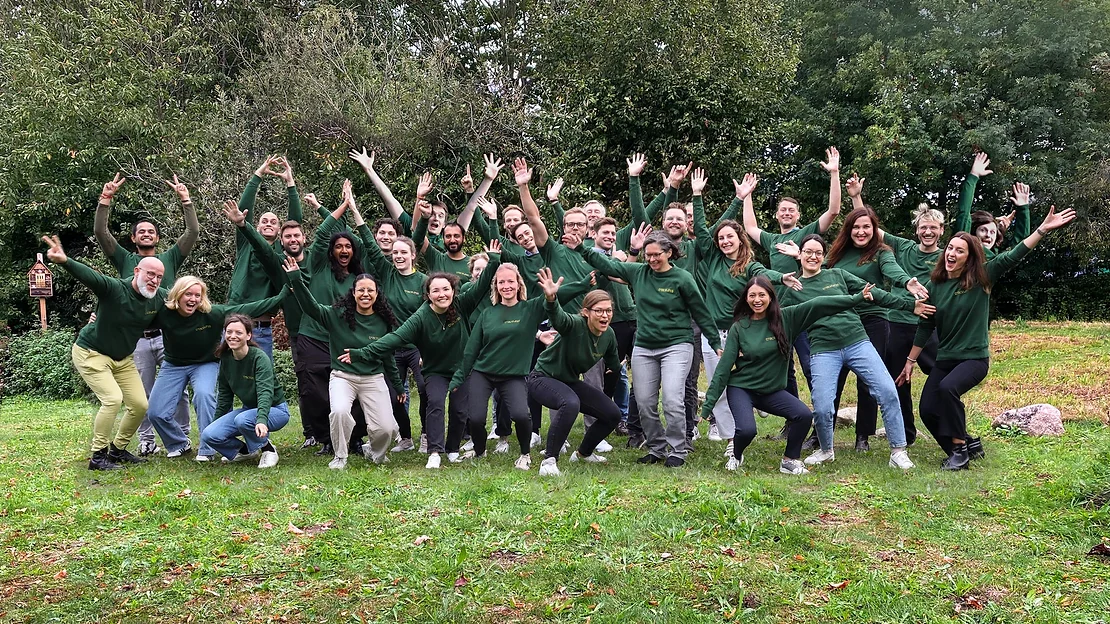
Anne Lamp took the bold step in 2020 and founded traceless together with Johanna Baare, a trained economist. “For me, founding a start-up meant a certain change,” she said at the time: “I had to take off my purely scientific glasses and suddenly think in business terms too.” Advice was provided by the Startup Port, and the first financial start-up aid came from Hamburg Innovation‘s “Calls for Transfer” funding program. The traceless team, which now has around 40 members, has set itself the goal of replacing plastics in large quantities by demonstrating for the first time that the innovative process can be implemented on an industrial scale. Parallel to the technology scale-up, the continuously growing company is developing pilot products made from traceless® materials together with customers and partners.
Thanks to its innovative solution, the company is being funded by the EU as part of the EIC Accelerator. In addition, the company has already received several awards, including the German Start-up Award and the German Sustainability Award/Next Economy Award.
traceless offers a solution to global plastic pollution and the associated climate change, scarcity of resources and loss of biodiversity. This makes traceless a pioneer for the green transformation of the industry.
Future summit instead of crisis summit: A new roadmap for the chemical industry
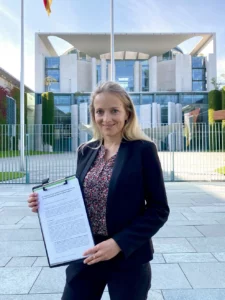
Yesterday, co-founder and CEO Anne Lamp was the only representative of a greentech start-up to take part in the Chemical Summit at the Federal Chancellery, where a joint roadmap for a fossil-free transformation was presented. The aim was to counter the doom and gloom that prevails in the traditionally fossil-based and energy-intensive chemical industry with a positive outlook for the future. Because there are solutions: A joint position paper was drawn up advocating a fossil-free transformation, regenerative and efficient solutions and a genuine strategy for the future. The declaration is backed by an alliance of almost 30 innovative circular economy players from various areas of the circular value chain that was initiated at short notice. Details can be found in the jointly published eight-page position paper.
Further information on the founding history of traceless materials via Startup Stories
UB FOREST INDUSTRY GREEN GROWTH FUND UB FIGG is a private equity fund that invests in companies focused on the replacement of plastics and other fossil fuel-based materials, the higher value and more efficient use of wood and agricultural by-product streams, and the increased use of these raw materials in a wide range of intermediate and end-use applications. Through its investments, the fund aims to support the forestry and timber industry in developing solutions to mitigate climate change. UB FIGG is a signatory to the Operating Principles for Impact Management and reports on the environmental and climate impact of its investments.
SWEN BLUE OCEAN CAPITAL PARTNERS is one of the leading providers of responsible private equity investments in Europe with assets under management of around EUR 7.7 billion and offers a wide range of investment programs for institutional and private clients. Since 2012, the fund company has integrated ESG criteria into its entire asset management and has implemented a climate strategy since 2017. In 2021, it strengthened its measures for fairer and more sustainable growth with the launch of Blue Ocean. SWEN Capital Partners is owned by OFI Invest Group, Crédit Mutuel Arkéa and part of its team. Since January 2022, SWEN Capital Partners has been a co-partner of the NEC initiative, which has developed a methodology that enables socio-economic actors to measure their contribution to the ecological transition in order to build a responsible and sustainable economy.