Jondi & Moon

Business idea: Sustainable waste prevention as a business idea
Industry: Packaging / E-commerce
Year founded: 2021
The founders want to reduce packaging
Category
On this page
Jondi & Moon: Sustainable waste reduction as a business idea
Jovanka Backhus and Randi Kittlitz studied social economics with a focus on business administration and finance at the University of Hamburg. The interdisciplinary nature of the course taught them that profit-oriented business can also function in an environmentally friendly, social and fair way. This inspired them to found a company to counteract climate change: “beyourpilot” provided helpful support (Editor’s note: “beyourpilot” has been operating under the “Startup Port” brand since July 2023) .
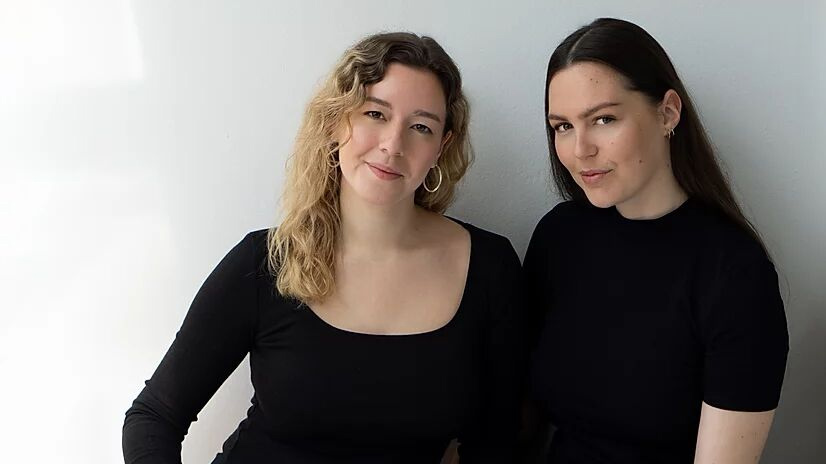
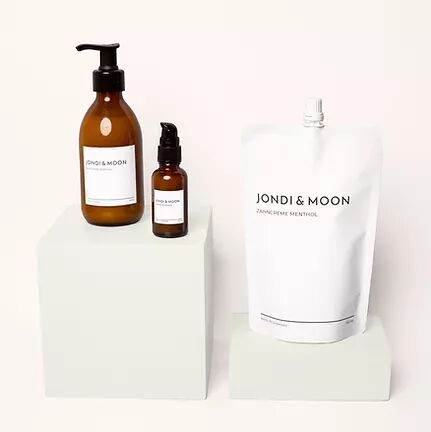
The two students met in their second semester at the University of Hamburg: Jovanka Backhus and Randi Kittlitz are both studying social economics there with a focus on business administration and finance. “As part of the ‘Building a Startup’ seminar, we had to work in groups to develop a business plan. For us, the idea had to be realistic: We pay attention to sustainability in our private lives, eat a vegan/vegetarian diet and are also otherwise consciously on the move. Out of this motivation, we wanted to make a contribution to more sustainability in society and finally came up with packaging. So we looked around our home to see where they were problematic or inconvenient: That’s how we came up with toothpaste,” Jovanka reports. The Hamburg-born women saw great potential in toothpaste in particular, because regularly buying more of the often non-recyclable tubes leads to an extremely large amount of packaging waste. This is a problem that the two founders want to tackle.
Complementary expertise regarding the business idea
“We are neither from the packaging industry nor from the pharmaceutical or cosmetics sector, but we are attentive consumers. We gathered the expertise we lacked,” Randi explains. The first product of her young company “Jondi & Moon” is to be refillable toothpaste in a glass dispenser. In a Facebook group at the University of Hamburg, the founders found a pharmacy student who had completed training as a pharmaceutical technical assistant. A first suitable formula was then developed in the chemistry department of the University of Hamburg. The lecturer at the seminar, Sven Niederhöfer, thought their idea was great and supported them accordingly. The foundation would become more and more serious and concrete.
Solid support regarding business development
The first big hurdle for the start-up was funding: “Through our studies we already had a business foundation. The start-up department of the University of Hamburg as well as the beyourpilot start-up consultant Dr. Bettina Otto (Editor’s note: “beyourpilot” has been operating under the “Startup Port” brand since July 2023) provided us with further necessary know-how regarding the start-up. Together with her, we successfully applied for the start-up grant EXIST. Without this financial support, we would not have been able to found a company. In addition, bit by bit, more contacts within the start-up scene were established,” Randi continues. In the application for the EXIST start-up grant, a funding programme of the Federal Ministry for Economic Affairs and Energy co-financed by the European Social Fund (ESF), the two of them beat out numerous other start-up ideas with their idea.
Various challenges during the start-up process
But everything didn’t always work out right away: the early days in particular were stressful: “From developing the toothpaste with an expert to glass design or good marketing strategies: Here and there we kept encountering new challenges that had to be mastered. And, of course, our studies continued on the side and wanted the appropriate attention,” Jovanka explains.
It was not easy to rely on external expertise: “We constantly asked ourselves whether everything was right. Or are they reflecting their own interests and just trying to sell us something? What is the most sustainable thing? We had to do a lot of research and cross-checking because we didn’t want to be taken to the cleaners,” Randi reports. “The packaging industry is also often quite conservative and male-dominated. And there was often a serious age difference. It was a challenge to hold our own in the conversations. Both of us had previously been employees and now had to negotiate as young female bosses. We were not used to that. Not everyone wanted the best for us and we had to stand up to them. That’s why the training we received through EXIST was worth its weight in gold, in which we were trained in appearance, negotiation and team building,” adds Jovanka.
Learning the hard way
When asked what they would have done differently today, for example, Randi reports: “We initially worked with a product designer from our circle of friends. Because of the friendship, we unfortunately took too much of a leap of faith when it came to signing the contract. That really escalated and cost us a lot of money as well as nerves. Learning: You have to sign the contract before the first step! Make sure you are legally covered, no matter who it’s about!” With the mistakes that were made, Randi and Jovanka often simply didn’t have the knowledge yet and could only find this out in advance to a limited extent. In addition, they would have liked to allow more time buffer to get into less stress. With regard to development, they advise letting go of the initial idea at some point in order to develop it further. It’s also okay to cut back sometimes in order to move forward. “And to put it in general terms: in the beginning we took a lot of things personally because of our empathy. Over time, however, this has become relative, as we have learned and now see many things more calmly,” says Randi.
Convincing consumers of a sustainable product
“I worked at H&M for seven years. At that time, the idea of trying to convince large corporations to be more sustainable already came up. The topic is also very present at the University of Hamburg nowadays. The more you learn about it, the more meticulous you become. Even we, who consider ourselves to be quite enlightened in this respect, were surprised at how much we can still do wrong or improve. The goal of Jondi & Moon is to convince consumers who are still sceptical about sustainable products. From disposable razors to tampons to plastic shampoo bottles: the cosmetics sector, for example, is full of various environmental offenders. But at least there is now environmentally friendly shampoo in one piece on the drugstore shelf. The situation is different with toothpaste tubes, however. The willingness to consume more sustainably already exists among a large part of consumers, but the market still offers a lot of room for plastic-saving products that are attractive to consumers in all aspects and guarantee a completely transparent supply chain,” Jovanka notes.
Zero waste’ as a long-term goal
“We both grew up in an environmentally conscious and modest household. In other words, a working-class household rather than an affluent one. This has given us direction and always grounds us or keeps us grounded – an important aspect in the wild start-up industry,” Randi explains. The short-term vision of the two founders is to improve their product. The glass containers are to be replaced by reusable jars later on. In addition, a bag made of purely virgin material is used; this is to be replaced by recycled material in the future. In addition, Jondi & Moon wants to establish itself in various sectors such as the hotel industry: “We would love to replace all these little sachets! From hotels to aeroplanes: we believe that a lot of unnecessary waste is produced there. That’s why we want to show possible alternatives and, if possible, change the market in this respect. The long-term goal must be zero waste,” says Randi. Zero Waste means: Zero waste. It means trying to produce as little waste as possible and recycling everything that can be recycled. It is about reducing waste in one’s own household, in the office, on the road, but also nationwide.
Convincing the masses of sustainability
The founders had their product launch on the first of December 2021. Corona has also affected their business: There were supply bottlenecks regarding the material. In addition, the toothpaste had different properties in production than in the sample. This delayed production, but they are satisfied with the final product. With regard to distribution, the two are confident: “We are represented in four shops so far (Mimulus Naturkosmetik, Quiddje Design, Claudia May Concept Store and online at Gaiastore). Our goal is to reach the masses: It should be easy to live sustainably! Of course, we hope that many people will switch to our products and that we can reduce the amount of plastic waste. In the long term, the toothpaste from the jar should also be available from large suppliers such as drugstore chains,” says Jovanka confidently.
More information about the start-up Jondi & Moon can be found on the start-up’s homepage.
The products of Jondi & Moon are available for purchase in the online shop.