

Students with a migrant background find it difficult to start a business in Germany. This is a missed opportunity to create innovations and jobs, emphasize the Startup Migrants in particular. This is where the Startup Preschool initiative comes in with a three-day crash course in entrepreneurship, which took place last weekend in Hamburg in collaboration with Startup Port. We spoke to Norhan Othman, Head of Startup Migrants, who would like to see stronger networking and collaboration between local companies, incubators and startup hubs with international specialists and young students.
Can you describe the structure of the Startup Preschool program and how it is tailored to the needs of international students and researchers?
The main goal of the Startup Preschool is to bring international talents, both students and professionals, into contact with the startup ecosystem of the respective city. During the Preschool, they get to know the various players in the startup ecosystem. They learn how to found a startup if they have the right idea. We put them in touch with startup support organizations that can help them if they need coaching, mentoring and funding to turn their idea into reality. They will also find out which events they can attend to form teams and take their own ideas forward. Participants will also learn more about the different legal forms of companies in Germany and how they can legally start their own business.
How do the participants in the program manage to develop a viable business model from a product idea in such a short time?
The Startup Preschool takes place over three days: Friday, Saturday and Sunday. During these three days we have startup coaches who help the participants to work on their own ideas. First, the ideas are discussed in general. Then they work in teams on the ideas they have already submitted in their applications. They then work step by step to create their own pitch decks. At the end of the third day, there is a pitching session in which everyone presents their ideas and receives feedback from the startup coaches. They then discuss with them how to proceed and which follow-up programs they can apply for after the Startup School in order to further develop their ideas.
What unique aspects of the local startup system will be highlighted during the event? And why are they important for potential international founders?
The participants get to know the players in the startup ecosystem and can exchange ideas with them. They learn more about the various offers of the startup scene – especially for the early phase. They also learn how to structure their own ideas so that they can later participate in an incubation program. In the process, they build up their own network and exchange ideas with like-minded participants. They also get to know international founders who talk about their own start-up journey in Germany and the challenges they had to overcome.
How long has the Startup Preschool been running? Can you tell us something about the experiences or success stories of the international founders who have already taken part in this program?
The program has been running since 2019 and takes place in different countries such as Norway, Austria, Sweden, the United Kingdom and Germany. We have participants from different backgrounds, some just want to explore the local scene and learn more about startups and the topic of founding in order to eventually found, join or work in a startup themselves. Others already have concrete ideas that they want to work on and develop further during the Startup Preschool.
One team that took part in the Startup Preschool in Berlin, for example, developed a platform on which musicians can post their offers and be recruited. After completing the Startup Preschool, the team was able to apply for the Berlin Startup Scholarship and received it. The most important thing is that we try to create a pipeline for the talents. This way, they know where they can go once they have finished the Startup Preschool and take further steps on their entrepreneurial path. We are very happy about our participants who have managed to go their own way, get funding and thus realize their own ideas.
What are the biggest challenges for international students when they set up a company in Germany? And how does the Startup Preschool deal with these challenges?
On the one hand, there is the language barrier: everyone thinks that if they contact an institution, they won’t find anyone who will answer them in English. Many then keep their idea to themselves and don’t develop it any further. This is because they don’t know what support they can get. At the Startup Preschool, we help them to make contact with interest groups and contacts in the various institutions who already speak English. This way they know that they can turn to them with their questions. In this way, they begin to build fruitful relationships with the various institutions.
Foreign students know very little about the opportunities for supporting start-ups in Germany, not even about the start-up hubs at their own universities. And that also applies to most startups in Germany. It was really surprising to see that the startup hubs at the universities have very few international students, even though around 25 percent of students at German universities have an international background.
That’s why we try to bridge the gap between international students and the startup ecosystem as much as possible. We do this for a wide range of disciplines so that we can ensure that ideas from a very broad range of disciplines and backgrounds are supported.
How does the regulatory environment and Germany affect international students who want to start a business? And what advice would you give them on how to deal with German bureaucracy?
I think the main problem is that there is currently no clear legal status for people starting a business in Germany, e.g. for students who want to set up their own business after graduating. They can’t because they need a residence permit to be able to stay here. To obtain a residence permit, they need a permanent employment contract. This means that they cannot stay in Germany after their studies if they do not have such an employment contract. Of course, this also means that they cannot set up their own business. But we try to communicate this problem to the other players in the scene.
We look for ways to enable them to realize their own ideas and, of course, obtain their own residence permit. In many cases, we advise them to work part-time on their start-up ideas and keep their main job in order to retain their residence permit.
What resources are available to international students and businesses in general? And how can they effectively access these resources?
There is a whole range of funding programs. But they are not always well known to students. Here in Germany, there are start-up grants in almost every federal state, such as the Gründungs- and EXIST-Stipendium. These can help talented people work on their ideas by paying them a kind of salary so that they can mainly work on their idea without having to have some kind of full-time job to earn a living.
At the moment, the number of grants of this kind is limited. But I think there should be more opportunities like this so that more start-up ideas can be realized.
Can you talk about the importance of networks for international students starting a business in Germany and how they can build a supportive community?
I would say that in the Startup Preschool we are trying to help them build such a community and network. We want to bring the international students together with the different institutions supporting startups in Germany. We are always convinced that cooperation is very important to be successful in the startup scene and to take into account the different backgrounds of the scene.
With the Startup Preschool, we want to give international talents the opportunity to network and get to know other people who might be interested in founding a company. And of course, we also encourage them to participate in various other networking events to find the right team members or co-founders. We try as much as possible to make sure that they are well informed about these events so that they can start their own community after completing the three-day program.
What role does cultural integration play in the success of a company founded by foreign students in Germany?
I think we have found in dealing with various international students that it is always overwhelming to come to or move to a new country. You have to learn the language, you have to build your own network, you’re basically starting from scratch. And then you start studying and want to do your Master’s, Bachelor’s or PhD. So you have to start from scratch and concentrate on many things. This makes it somewhat difficult for people interested in founding a company to explore the various opportunities in the German ecosystem, for example. It is therefore very important that the various players involved in supporting start-ups become active on several levels.
The new arrivals are undoubtedly needed on the domestic market. For this reason, it is important to accommodate them, but also for the support institutions to work together. To ensure that the international community is empowered and can give their best to the local community, it is really important to work on these aspects and give them tools so that they can integrate easily and understand the system as much as possible.
What key skills should international students focus on to increase their entrepreneurial success in the general market?
First of all, they have to observe the market closely. They need to see what is already there, what is happening and what is really needed, what challenges the market is facing and what problems or opportunities there are. This also has to do with understanding the culture and being integrated into the community, because when you are integrated into the community, you understand better what is really needed.
If you want to start a company, you need a strong network. You need communication and social skills, you need to go to events and talk to people. And you have to make sure that you are constantly learning, that you are constantly expanding your knowledge.
You need to understand the different tools that can help you. I know that sometimes, unfortunately, international founders don’t have a lot of time to do that. But I think there are a number of events, such as “What Startup Migrants do” and other events that take place in this context, to get concentrated information in a very short time to understand the scene.
Of course, you also have to learn the German language. But that also takes time in order to be suitable for everyday life. It’s important not to be afraid to knock on doors, approach the various players in the scene and find out more. It’s sad that many ideas from international students get lost because they can’t talk to anyone about them and don’t know what funding opportunities are available. They don’t know if their ideas are welcome. There are many startup funding institutions that can help if someone has a startup idea, there are accelerator and incubation programs. That’s why we always advise people not to be afraid to talk to people and express their ideas, because that way they can get the right help.
How satisfied were you with the Preschool at the weekend, which was organized together with Startup Port?
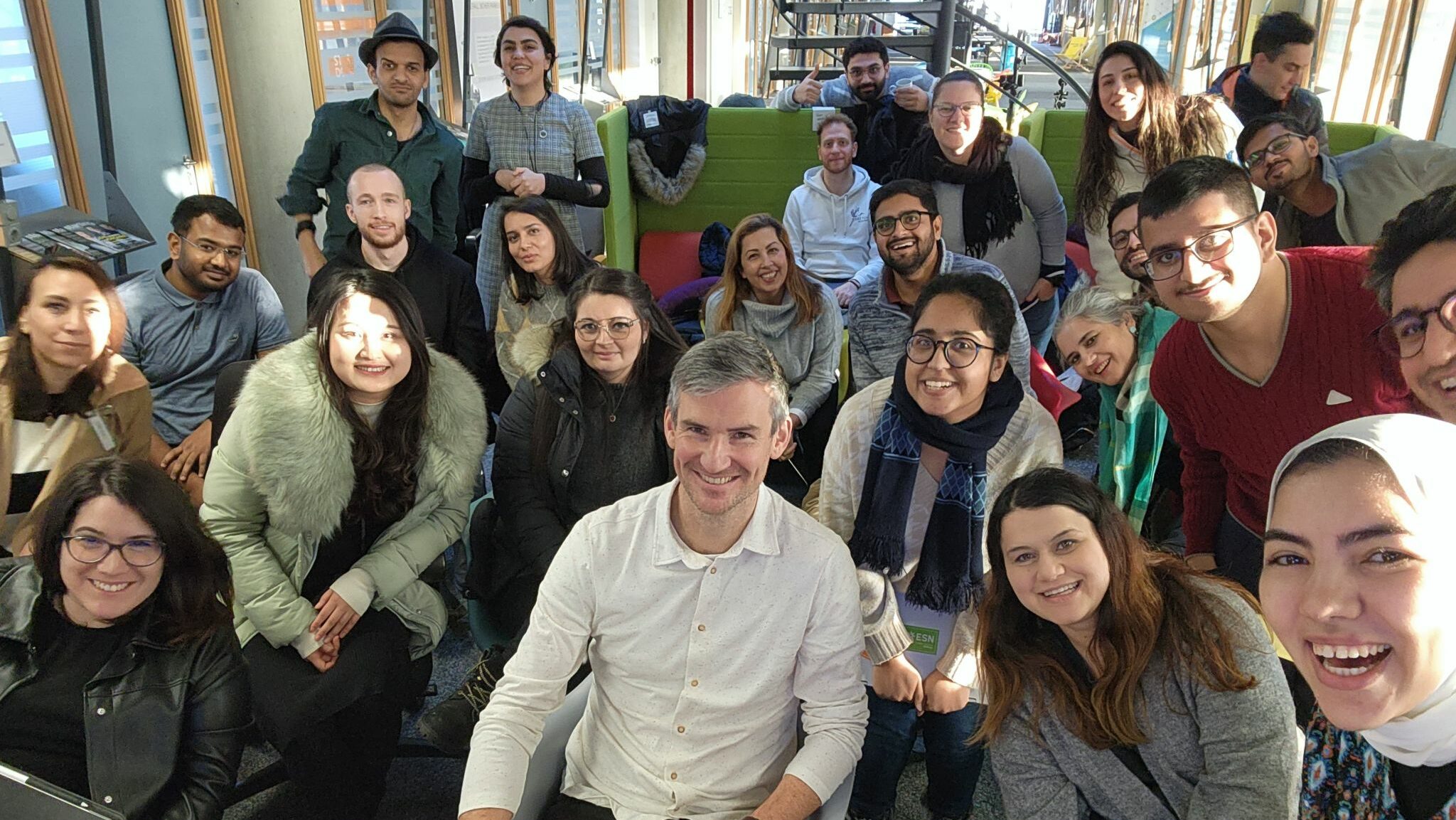
The Startup Preschool was organized for the first time in Hamburg in cooperation with the Startup Port Team. We noticed a great demand from international students and professionals living in Hamburg, who brought brilliant ideas for the weekend. The space at Startup Port was perfect for them. The participants had the opportunity to get in touch with Thorsten Sobe, the founder of Elbwire GMBH, and learn from him about his start-up journey in Hamburg. They were also able to find out about the startup ecosystem and funding opportunities.
When will the next event of this kind take place in Hamburg?
We are working closely with the Startup Port team to find ways to hold such an event more often in Hamburg and, above all, to find the right funding for it. We hope to hold the event four times a year in Hamburg to reach as many international talents as possible and give them the opportunity to realize their own startup ideas.