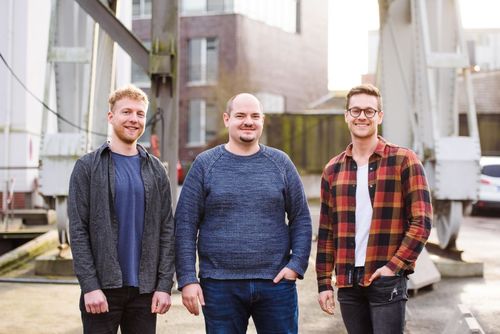

The start-up Plancraft has been receiving the EXIST start-up grant from the Federal Ministry for Economic Affairs and Energy (BMWi) since January 2020. Our editor met with Julian Wiedenhaus for an interview about this.
The right tool for craftsmen: Plancraft delivers. Behind the start-up is the three-founder team Alexander, Richard & Julian. Together, they combine knowledge from the fields of craftsmanship, software, business and civil engineering. Plancraft has received the EXIST start-up grant from the Federal Ministry for Economic Affairs and Energy (BMWi) since the beginning of 2020. The founders work in an office in the Startup Dock start-up center in Harburg.
How did you come up with the idea of Plancraft?
The idea was born in 2018. Alex’s father has a carpentry business with almost 25 employees. Everyone there was unhappy with the order processing software. It was far too complicated, technologically outdated and therefore restrictive and slow. Alex then looked for new software, researched for a long time and finally found a solution. After the costly changeover and a four-figure license fee, it was clear that the desired added value would not be achieved. The software was just as poor and complex to implement, with the only difference being that it was not from 1998 but from 2010. The whole thing was then abandoned and Alex recognized the potential of innovative software. He brought me on board. Based on the Lean Startup Playbook, which we knew from our studies, we then conducted interviews with other companies in the network and discovered that there were a lot of construction sites in this area. We took a lot of ideas with us and spent six months developing a concept together with Richard, slowly working our way towards the idea we are pursuing today.
And what exactly does the idea look like?
Our flexible web app simplifies order processing for tradespeople. Every tradesperson can quickly get started with the application, onboarding is easy and the user experience is unique. The SaaS solution is very intuitive and supports the user with an intelligent search to quickly create documents. At the same time, the software has the flexibility of a cloud application and is platform-independent. And all this without time-consuming installation or annoying updates. And it even runs when there is no internet available.
Later on, we would also like to move towards machine learning support and for companies to be able to share all documents on one platform when they are working on construction projects. That’s a dream of the future, but that’s where we want to go.
Can you describe in more detail what problem you are solving?
Craftsmen are chronically overworked, order books are bursting.
The problem is that foremen and managing directors are also tied to order processing. They have to write technically correct quotations for customers, calculate measurements and keep track of orders. Today’s solutions are either old-fashioned software that needs its own server. Or poorly implemented web apps that promise improvement but are just as complex, specialized and ultimately overwhelming for the craftsman. Plancraft is the first PGA (Progressive WebApp) to set new standards in terms of UX, focused features and intuitive usability. To ensure this, we have been working with tradespeople to develop easy-to-understand and simple solutions since the company was founded. Whether a carpentry firm with 25 employees, a joiner with five or a one-man drywall builder – diversity helps our product.
What motivated you personally to found a startup?
I took a leave of absence from my work at Airbus for my Master’s degree, which was not dual. In an entrepreneurship module, I gained my first start-up experience in a project with Alex. Alongside my studies, I did student consulting at Hanseatic Consulting, where I also had contact with start-ups. I found these agile working methods inspiring, I didn’t know that from my life in a large corporation, I really wanted to do that – that’s my fulfilling career path. After my Master’s degree, I worked at Airbus for a whole year, developing Plancraft at the same time, and I’ve been doing this full-time since the end of 2019. Since then, we’ve all been able to live by the credo “No more Mondays” – it’s just fun to help a neglected target group like tradespeople.
We wish you every success with plancraft.de and thank you for the interview, Julian!
Background
Alexander Noll (26): Alex completed his bachelor’s degree in civil engineering at the Technical University of Hamburg (TUHH). At the same time, he trained as an energy expert at the Elbcampus. He also completed his Master’s in International Business and Engineering at the TUHH and graduated in 2019. During his studies, he already dealt with software development, continued his education autodidactically and took on working student positions as a developer. It was during one of these jobs that he met Richard at Etventure, a subsidiary of the consulting firm Ernst & Young. Alex has a connection to the trades, as his father owns the Noll carpentry business in Tostedt near Hamburg, where Alex grew up.
Richard Keil (35): Richard was Alex’s mentor at Etventure. He is the IT expert in the team, started out as an IT specialist and has many years of professional experience in web design/web development in agencies, corporate start-ups and consultancies. As a full-stack developer (meaning he can program frontend and backend), he has been working full-time at Plancraft since the end of 2019, just like the others. Richard was born in Munich.
Julian Wiedenhaus (27): Julian is a trained mechanical engineer. He completed both an apprenticeship as an aircraft mechanic and a Bachelor of Engineering at Bremen University of Applied Sciences as part of a dual study program at Airbus in Bremen. Like his co-founder and fellow student Alex, he completed his Master’s in International Business and Engineering at the TUHH and graduated in 2018. Parallel to Plancraft, Julian worked as a project manager at Airbus until 2019. He comes from Bielefeld.