vilisto

Business idea: Digital heat management solution
Industry: Sustainable technology
Year founded: 2016
Heat management with self-learning thermostats and the collection of data that can optimise the operation of a building
Category
On this page
vilisto's solution recognises when a room needs heat
vilisto develops a digital heat management solution based on thermostats with integrated presence detection, learning algorithms and indoor climate sensors. Christoph Berger was inspired to found the company in 2014 by a semester abroad at the University of California and the simple yet effective sign “Want to start up? Come by!” on the campus of the Hamburg University of Applied Sciences (TU Hamburg) from the Startup Dock (editor’s note: Startup Dock is now called Startup Port @TUHH), which had just been initiated at the time.
The business idea came about during his energy technology studies at Hamburg University of Technology (TU Hamburg): Christoph Berger wrote a project in his Master’s degree that involved predicting room temperatures in unknown rooms and buildings. He worked with algorithms that take into account the outside temperature and solar radiation. “I started studying energy technology early on. At the TU Hamburg, we have a climate container at the Institute of Thermodynamics. The challenge there is to air-condition it as energy-efficiently as possible,” reports the founder.
In between, he spent a semester studying abroad at the University of California, Berkeley (USA): “At the time, Google had just acquired the thermostat and smoke detector manufacturer Nest for 3.2 billion dollars. Oh, I thought, I’m working on a topic like that: there’s a market for it! However, Nest was very specialized in the US market. Here in Germany, there are fewer air conditioning systems in comparison, but we do have radiators…”, Christoph noted. In 2014, the student returned to the TU Hamburg. He came across a sign on campus: “Want to start up? Come by!” advertising the startup Dock that had just been founded (Editor’s note: Startup Dock is now called Startup Port @TUHH). A sign for him.
From scientific work to “Most Innovative Business Idea”
“I had two start-up ideas in mind at the time: one had to do with drones, the other with my project work. After exploratory talks, I quickly leaned towards developing the project work. I think it was good that I had no idea what I would have to do. Otherwise I might not have started at all. The impetus came from my studies at Berkeley, where almost everyone had something to do with start-ups. In contrast to Germany, where I hardly knew anyone in this field,” says Christoph. That was soon to change. A product idea emerged from the concept of the scientific work, which was put through its paces in terms of the business idea by consultants from the Startup Dock. The Startup Dock consultant assigned to vilisto enabled Christoph to take part in the E.ON hackathon at the end of 2014. After two and a half days, the company’s CEO Dr. Johannes Teyssen awarded Christoph and his team the “Most Innovative Business Idea”. “If they think it’s good too, it could be something,” said the now graduate. So he put together a start-up team to apply for EXIST funding.
The team
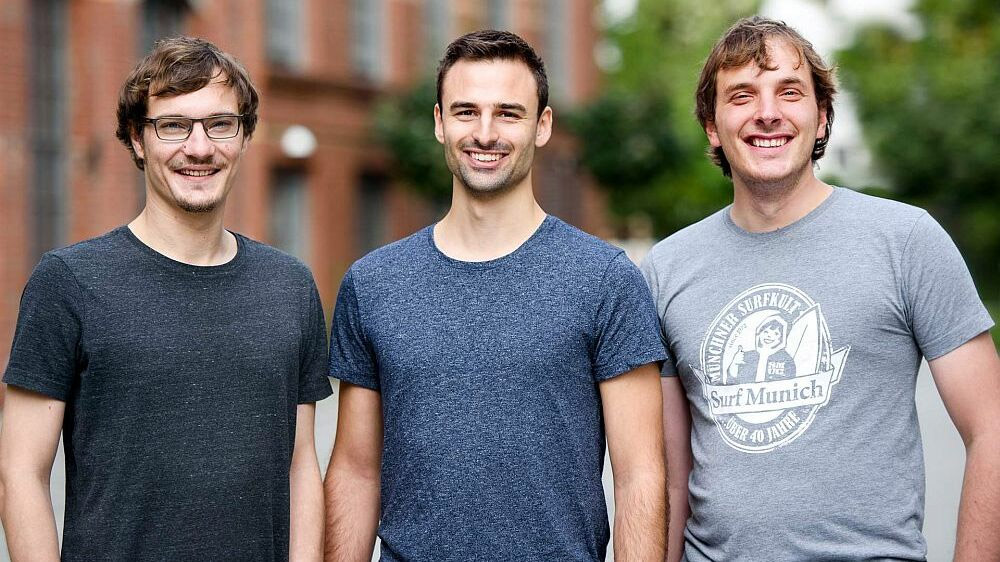
Christoph had known his current Technical Director Lasse Stehnken for three years through a fellow student. Born in Kiel, he was working in Munich at the time and wanted to return home. Hamburg was close enough for him, he liked the subject and they liked each other anyway: it was a good fit!
Malte Lennart Marwede was briefly the third founder in the group: “We met Malte at the Institute for Product Development. He completed the classic McKinsey program and initially helped us with EXIST – but then left after six months for personal reasons,” reports Christoph. In the search for a replacement, he received around 50 applications and decided on Christian Brase, who was an ideal addition in sales and business development. Today, the start-up has 33 employees, 21 of whom work full-time.
Initially, vilisto employed working students to supplement the team. Christoph then hired the first full-time employees in October 2017: He knew Dr. Michael Heuer from his studies, for example. Together, they channeled the first simulation models. Michael originally co-founded another start-up, but Christoph was able to win him over to vilisto after some time: “The first hires have to be a good fit. That’s why it’s better if they come from the environment so that they can be better assessed,” emphasizes the founder. Christoph sees networks of people interested in founding a company as the next option. You need certain talents and a certain affinity for risk. In the advanced start-up phase, you can then use sensible sourcing to hire talent that you didn’t know before.
The product
After developing a minimal product (MVP), vilisto received its first investment and was able to develop a serial product. The start-up sells its product exclusively to operators and users of non-residential buildings in the B2B and B2G market: i.e. to companies, public administration and educational institutions. The users or employees of these buildings often do not bear the energy costs themselves. This has a negative effect on the motivation to save energy. “The thermostats automatically turn off the radiator when it is warm enough in the room. We go one step further and additionally turn down the radiator when no one is in the room. Because why should your office be heated at night and on weekends when no one is there? To do this, we have installed various sensors in the thermostat to detect and learn when the room is being used,” Christoph explains. Those who like it cosy and warm can still set the temperature themselves on the thermostat. Only when the rooms are no longer in use does vilisto automatically lower the temperature, saving up to 32 per cent in heating costs and CO2 emissions, according to its own figures.
Nothing fundamental has changed in the basic concept of the technology and the thermostat since 2016. Of course, these are constantly being refined, says the founder. The market will continue to develop significantly in the future and the company naturally wants to be part of it. It’s all about heat management with self-learning thermostats and collecting data that can optimize the operation of a building. The workforce is mainly responsible for sales, marketing, operations and technology development. The founders take care of business development and are still involved in all team issues. There used to be more manual work: “Originally, we received the parts and had to assemble them ourselves. The first 150 prototypes were created this way. Since the first series, we have been using our contract manufacturers not only for production, but also for assembling the devices, first in Tostedt and since the beginning of 2020 in Glinde,” reports Christoph.
The customers
The targeted customers have a large real estate portfolio: They are states, municipalities, DAX companies and SMEs. “We can already count various customers from Kiel to Switzerland and from Cologne to Berlin as part of our climate mission,” Christoph reported in an interview with Deutsche Startups. vilisto plans to further expand its customer base. In addition to awards such as the German Innovation Award for Climate and the Environment and the Perpetuum Energy Efficiency Award, sales partnerships have also been expanded.
The vision
The entire team at vilisto is working to achieve as much impact and high energy and CO2 savings as possible. We are driven by the vision of a CO2-neutral building stock in order to make our contribution to climate protection. There is enormous potential here. Building such a company can be very intensive. Moreover, it makes sense to enter into far-reaching partnerships at different stages of the company. This can also include a merger or a purchase of vilisto for further international growth, if this serves the overarching vision and our values are upheld in the process,” Christoph concludes.