Category
hoλos: A 3D navigation experience against distractions in road traffic
The number one cause of accidents in road traffic is distraction: the aim of the start-up hoλos is therefore to develop an intelligent system to combat this. With the help of augmented reality and the 3D parallax effect, the driver should gain a better overview of what is happening.
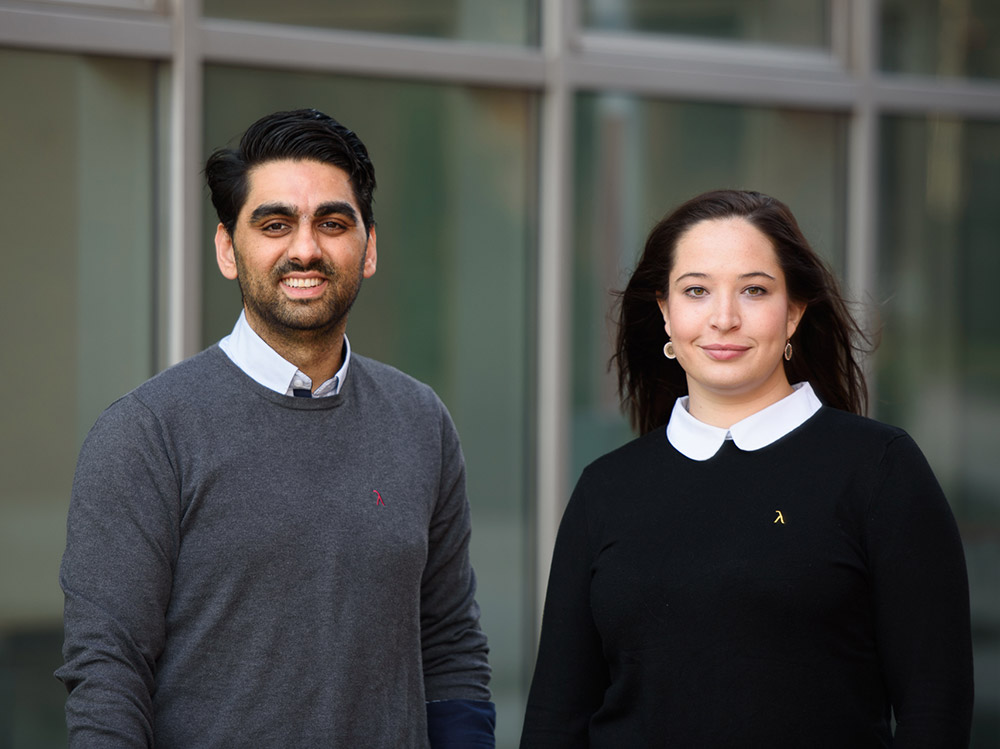
Marie-Christine König, Ekaterine Gelashvili and Mohamad Hamed Jalalzada received an “EXIST-Gründerstipendium” from the Federal Ministry of Economics in November 2019 with their start-up hoλos. The young scholarship holders are now receiving support from the nationwide start-up program at HAW Hamburg, which supports students, graduates and scientists from universities who want to realize their start-up idea. For one year, they receive a basic salary, a budget for material resources and appropriate coaching. “At the end of EXIST, we want to have developed a prototype. That is a must. We are also working on follow-up financing,” says Marie-Christine ambitiously.
The aim of hoλos is to develop an intelligent system to reduce “distraction at the wheel”. According to a study, this is the number one cause of accidents: every second driver uses their smartphone or looks down at the navigation system while driving. hoλos wants to use a 3D navigation experience to ensure that drivers do not have to take their eyes off the road. As no projection is used (as with a conventional head-up display, for example), the system also enables viewing from every angle of the vehicle and therefore for every occupant. This is easier on the eyes and also reduces the risk of accidents caused by distraction. “We want to make road traffic safer, because around 60 percent of accidents are caused by distracted driving. We have to reduce this figure! If you are distracted for just one second at 50 km/h, for example by looking at the navigation system, you are basically driving blind for around fourteen meters. That’s a relatively long distance without any real control – even at local speed,” explains Mohamad. A survey conducted by hoλos with over 1,000 participants revealed that over 80 percent feel distracted by a navigation system. The young start-up saw this as an opportunity to develop something relevant: hoλos’ answer to the problem is a new type of navigation system based on artificial intelligence, augmented reality and the 3D parallax effect. This makes it possible to integrate 3D models, such as the navigation system’s turn arrows, directly into the real street scene. This means that the driver no longer has to take their eyes off the road to look for directions.
Two cameras are used for this – one facing the road and one facing the driver. The camera facing the road works with artificial intelligence – this is Marie-Christine König’s field of work. Road signs, road markings and obstacles are recorded and recognized. This data is then processed and displayed with the help of augmented reality and the 3D parallax effect – this is Mohamad Hamed Jalalzada’s area of responsibility. The camera pointing into the passenger compartment records the driver and calculates the position of the head in relation to the camera. With this information and the use of the 3D parallax effect, the three-dimensional virtual objects can be adjusted in perspective. This allows the driver to see the display at a certain distance outside the vehicle.
It all sounds promising at first, but the young start-up was quickly brought back down to earth: “When we presented our idea to the first representatives of the automotive industry, they told us about their concerns regarding the necessary approvals. This is a problem in Germany in particular,” says Mohamad. “Before you get into this industry, you’ll go bankrupt because of the approvals,” were the words of one representative. hoλos therefore decided to rely on several pillars: The product is designed so that it can be used in all kinds of means of transportation and also in other industries that call up visual aids in a wide variety of passenger compartments, such as trucks, buses, trains, but also planes or ships. What is particularly important, however, is that it can be expanded as required for autonomous driving. The founders have also set their sights on the visual advertising industry and the retail sector. “We were recently in talks with two companies in this area. At trade fairs in particular, our analytical camera and the three-dimensional display offer good opportunities to present the products on display in an attractive way and attract the customer’s attention. But the system can also be used in the field of outdoor advertising: the camera recognizes a person’s gender and aligns the visual offer to their characteristics. For example, if a woman is recognized, she can be offered an appealing beauty product, etc.,” reports Marie-Christine. “We are implementing a pilot project for this in spring 2020 with a chain of stores that has around 250 stores across Europe,” adds Mohamad.
The hoλos team was formed in 2013 when Marie-Christine König and Mohamad Hamed Jalalzada met as part of their studies at HAW Hamburg. Marie-Christine, born in Villingen-Schwenningen, had just moved with her parents to the suburbs of Hamburg. Mohamad Hamed Jalalzada already had a long journey behind him: born in Kabul, Afghanistan, he moved to Pakistan at the age of two, fled to the Czech Republic seven years later, from there to Karslruhe and finally to his family in Hamburg. Together they studied mechatronics (B.Sc.) and then automation technology (M.Sc.). Mohamad then met Georgian Ekaterine Gelashvili, a social economics student with a Bachelor’s degree in finance and accounting, about five years ago while waiting tables – a good addition to the start-up’s skillset. They worked together on the successful EXIST application in 2018, since when Ekaterine has been part of the team as CFO and supports hoλos in the areas of marketing and finance.
The start-up received its first support in 2016, during her bachelor’s degree. At that time, their project was still an app. Mohamad’s brother told him about the start-up service at HAW Hamburg: “We engineering students don’t tend to have much to do with start-ups, but the business administration students already knew about the service,” says Mohamad. So they introduced themselves to Angela Borchert, applied accordingly and were given an office. Along the way, they studied, attended various consultations and also worked as a student trainee at another start-up to gain experience.
“We were then recommended the ‘Calls for Transfer’ (C4T) program launched by Tutech in summer 2018,” says Marie-Christine. The program promotes the transfer of ideas, knowledge and technology at Hamburg’s state universities by supporting project applications with up to 30,000 euros. However, her application was rejected. “However, the detailed feedback from Anke Kayser helped us immensely to improve our general approach to applications. At the same time, we got to know beyourpilot (Note: The university network “beyourpilot” has been called since July 2023 “Startup Port“)which was in the process of being created. The start-up platform now helps us a lot with networking and gives us attention and a good overview of possible support,” reports Mohamad. “Ekaterine, for example, studied at the University of Hamburg and experienced different support options there than we did at HAW, for example. It’s good that beyourpilot has now made it less important which Hamburg university or research institution you attend in order to receive optimal start-up support. The Hanseatic city needs to network better so that we can make a real difference.”
Further information: http://www.holos-ai.de/